01 · Enterprise validation system
AEC Spec Validator
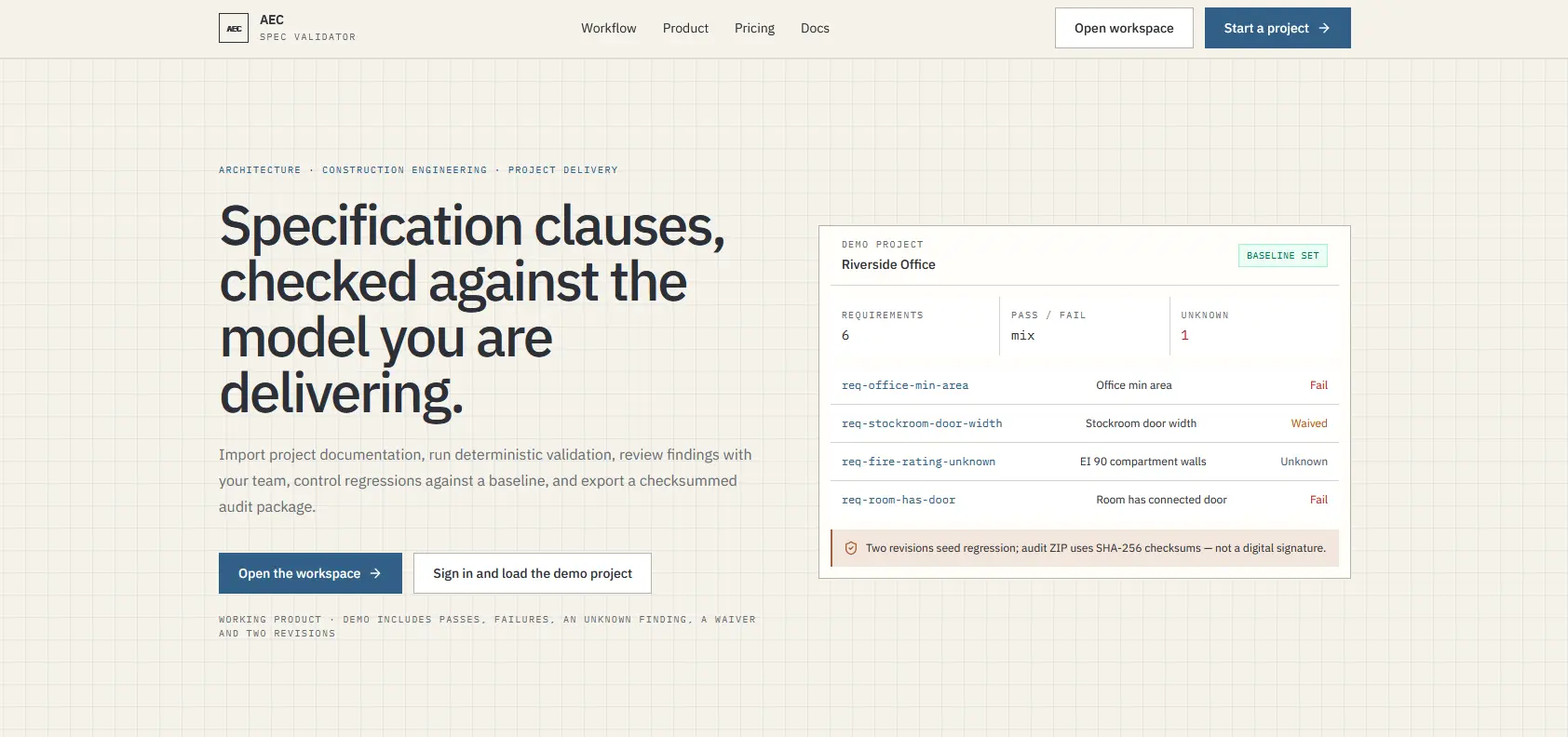
An evidence-first workflow that validates IFC model facts against reviewed requirements, preserves every decision and keeps AI outside the source-of-truth path.
Role
Product architecture and full-stack engineering
Core decision
Rules validate first. AI explains second.
Status
Functional beta prototype with QA gate
The problem
AEC compliance is rarely one calculation. Requirements arrive in PDF, DOCX, XLSX or IDS; model facts live in IFC; findings move through reviews and waivers. When those steps are disconnected, teams cannot reliably answer where a requirement came from, how it was checked or why a release was accepted.
The architectural decision
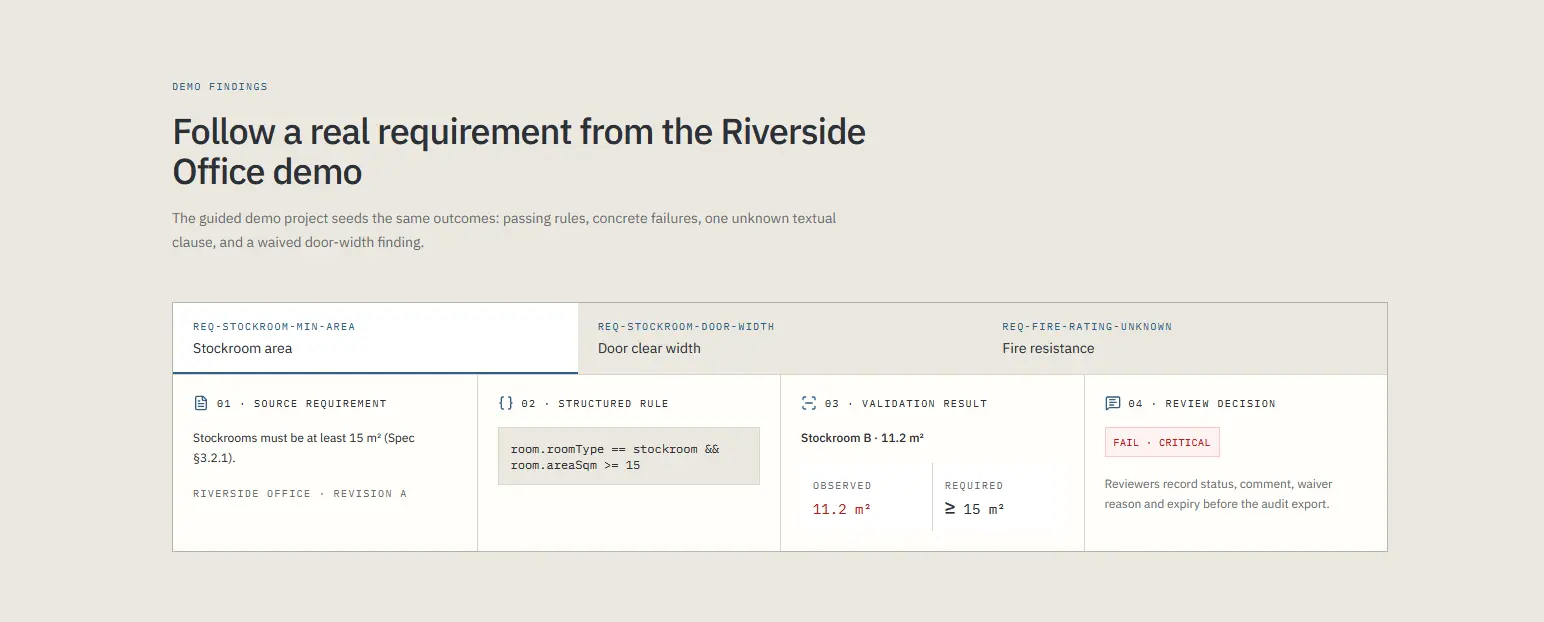
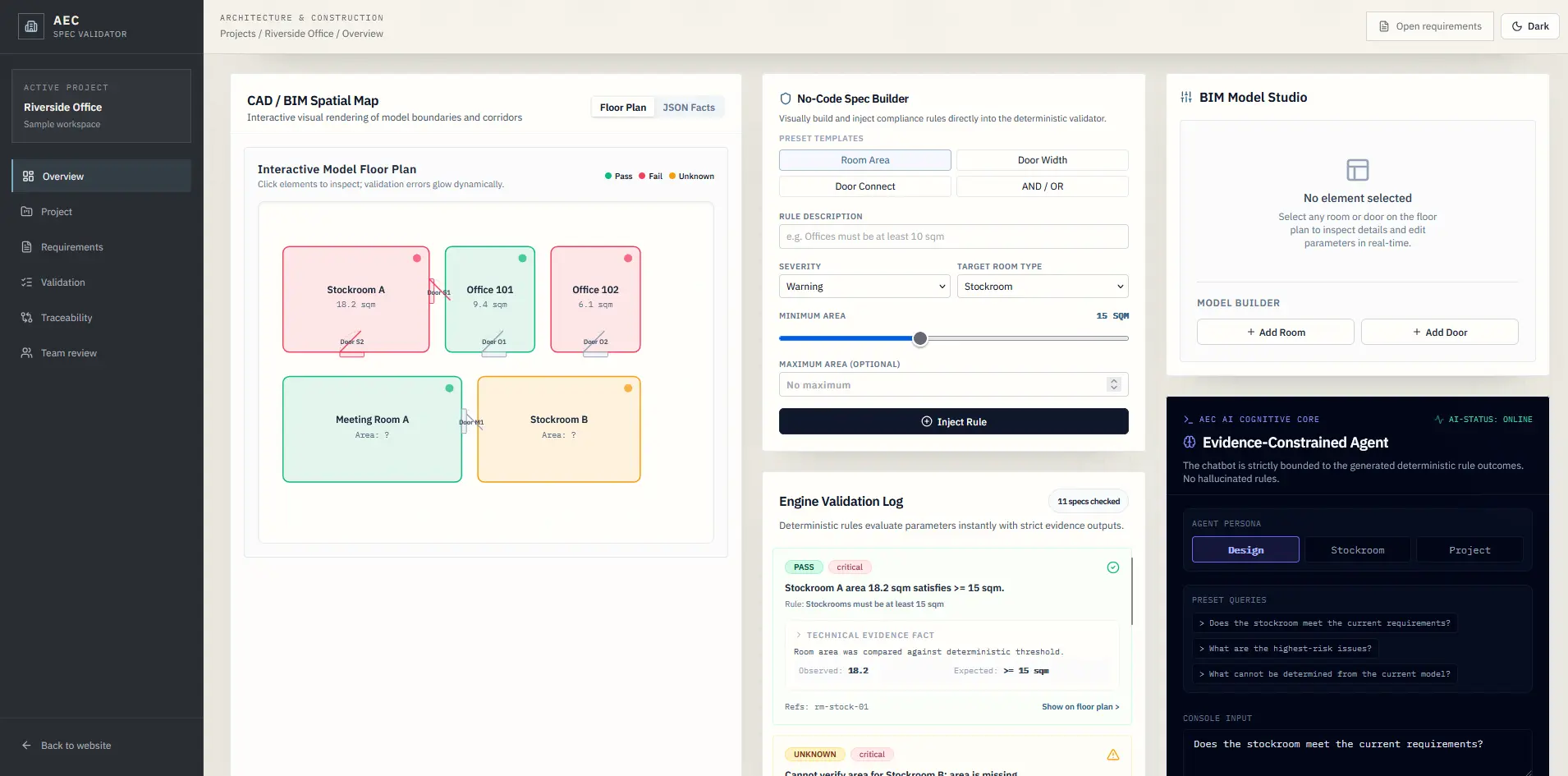
The LLM never decides whether a model passes. The server normalizes the model and requirements, runs deterministic rules and produces evidence. AI may only explain server-verified findings and must cite known requirement and element IDs. Invalid output falls back safely.
From specification to decision
Review sources
Import PDF, DOCX, XLSX or IDS and approve traceable requirement sources.
Normalize the model
Parse IFC2x3 or IFC4 facts with explicit units, provenance and diagnostics.
Validate deterministically
Produce pass, fail, unknown or not-applicable outcomes with observed evidence.
Review and export
Record decisions, waivers and attachments, then build traceability and audit exports.
What the repository proves
Evidence and traceability
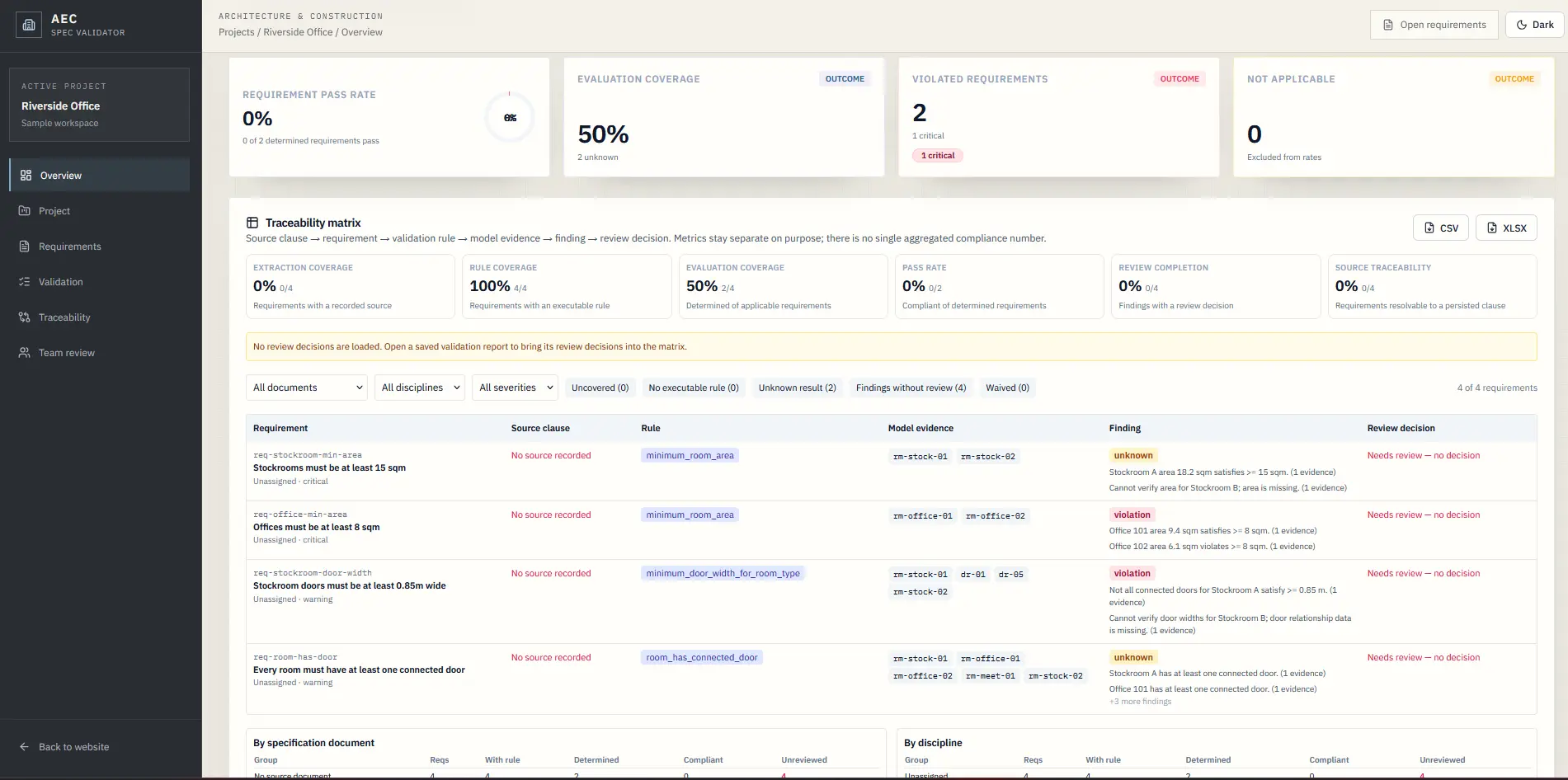
The matrix links source clause, requirement, rule, model evidence, finding and human review. Separate metrics prevent pass rate from hiding missing evaluation or source coverage.
Version and release control
Immutable specification revisions, baselines, regression reports and release policies expose new, resolved, reopened and changed findings.
Operational API surface
Scoped API tokens, idempotent uploads, signed webhooks, CLI output in JSON, CSV and SARIF, plus CI examples integrate validation into delivery workflows.
Production-style hardening
RLS, bounded uploads, brute-force protection, shared rate limits, background jobs, cancellation, retry policy, crash recovery and redacted logs protect the workflow around the engine.
Reliability boundaries
Missing facts remain unknown; they never become an automatic pass.
Evidence retains expected and observed values plus affected element IDs.
Audit ZIPs include immutable snapshots and SHA-256 checksums, explicitly not a digital-signature claim.
Chromium E2E, cross-browser smoke, accessibility, performance and dependency gates document beta readiness.
What this does not claim
This is not a certified compliance product, a complete geometry engine or a production Revit/AutoCAD add-in. IFC coverage is a targeted semantic subset, room classification remains conservative and official IDS reference-suite conformance is a separate gate.
Why it is the flagship
AEC Spec Validator demonstrates the full engineering arc behind trustworthy AI-assisted software: typed ingestion, deterministic decisions, evidence, human review, regression control, auditability, API delivery and explicit limits. The AI layer improves explanation without gaining authority over validation.
Private repository — code walkthrough available on request